Kadala and katain
From the lore of Ghostblood
Mathklyr is a land of ancient traditions, too many to list fully. From Emperor to slave, everyone is enmeshed in the Empire's culture, and such is the weight of tradition after thousands of years that those who do not respect it may as well not exist in the eyes of Mathklyrians. Most foreigners discover this to their dismay. In other countries, those who flout tradition are scorned, scoffed at or looked at with disdain; Mathklyrians simply… ignore them, as if they didn't exist. Should the offender commit a crime, of course, the guards will be all too happy to arrest them, or worse. Within the Empire's borders, those who do not follow Mathklyrian tradition are, quite simply, not thought of as sapient.
The kadala
The most basic tradition involves two objects, the kadala and the katain. The kadala is a piece of headwear for women: a delicate net of thin metal chains or strings, with a very loose mesh that leaves large gaps between them. The netting is placed over the hair up to the hairline, and from the center of its upper edge a teardrop-shaped gem hangs on the woman's forehead. The lower edge of the kadala may end anywhere from the top of the neck to the shoulders, as the woman prefers. The kadala also covers the sides of the head and ends just over the ears, where two hooks, one on each side, hold a diaphanous half-veil over the lower half of the face. The veil is thin enough to show the woman's features, but not so thin that it reveals everything.
The katain
The katain is the male equivalent of the kadala in significance, but rather than headwear it is a ceremonial dagger, worn at all times. The blade can be single- or double-edged, but the pommel is always set with a specific stone, whether a gemstone or a semiprecious one.
A language of stones
Neither the stone of the pommel nor the teardrop of the kadala is chosen at random. A complex language exists in which each stone denotes the wearer's social caste, and their position within it, so that two Mathklyrians who meet can immediately judge how to approach each other. Not even the Imperial Family is exempt from wearing the kadala or katain; their stone is the blue diamond.
Slaves are the only people in Mathklyr who do not wear the kadala or katain; in fact, they are forbidden from doing so.
The reasoning behind each stone is lost to time, though it may owe something to the now-extinct aossyr, whose ruling caste was known as the sapphire aossyr. Why Mathklyr, a human-centric Empire, would have adopted aossyr practices is unknown, and the theory may simply point to a coincidence rather than an intentional choice.
Read Ghostblood
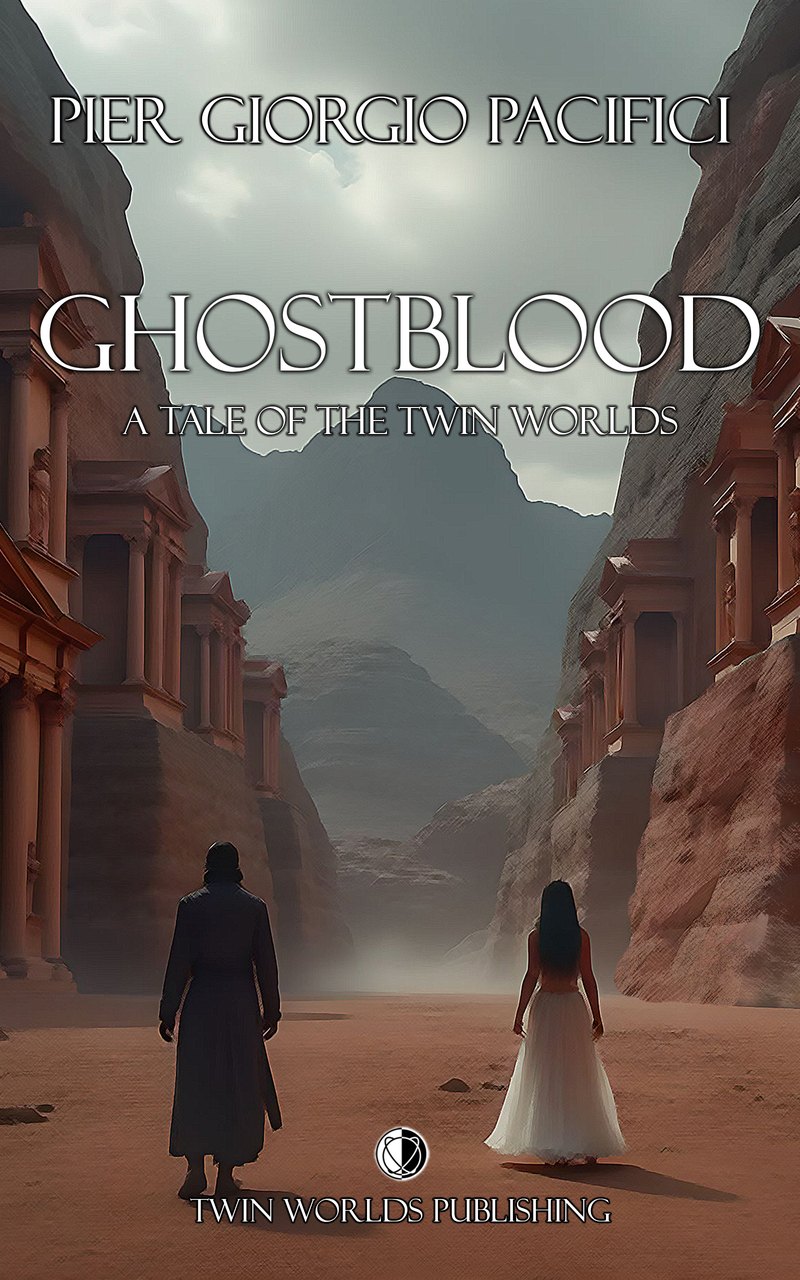
Revised edition
Ghostblood
An empire ten thousand years old, cursed never to die.
In Mathklyr, tradition is law and the goddess of fate decides every life. Alric chooses the soldier’s path and climbs. Elis refuses hers and is exiled for it. Years later she returns with knowledge that could break the empire, and the two meet again in the necropolis where emperors are crowned.
More from the Codex
- Mathklyr
The ten-thousand-year-old empire where Ghostblood is set, and why it is called the mummified empire.
From the lore of Ghostblood
- Lady Oinrin
Goddess of death, fate and sovereignty, and the power behind the Raven Throne.
From the lore of Ghostblood
- Ellemere
The last great forest of Teidar, and the one road its guardian allows through it.
From the lore of Ghostblood
- Nature magic
Magic that can’t be learned, only granted, and the three limits every practitioner knows.
From the lore of Ghostblood